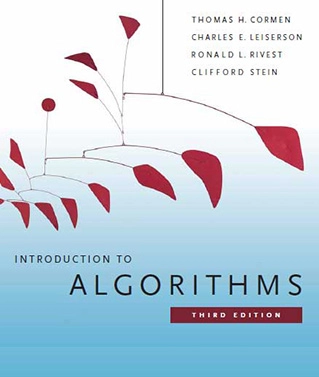
The latest edition of the essential text and professional reference, with substantial new material on such topics as vEB trees, multithreaded algorithms, dynamic programming, and edge-based flow.
Some books on algorithms are rigorous but incomplete; others cover masses of material but lack rigor. Introduction to Algorithms uniquely combines rigor and comprehensiveness. The book covers a broad range of algorithms in depth, yet makes their design and analysis accessible to all levels of readers. Each chapter is relatively self-contained and can be used as a unit of study. The algorithms are described in English and in a pseudocode designed to be readable by anyone who has done a little programming. The explanations have been kept elementary without sacrificing depth of coverage or mathematical rigor.
The first edition became a widely used text in universities worldwide as well as the standard reference for professionals. The second edition featured new chapters on the role of algorithms, probabilistic analysis and randomized algorithms, and linear programming. The third edition has been revised and updated throughout. It includes two completely new chapters, on van Emde Boas trees and multithreaded algorithms, substantial additions to the chapter on recurrence (now called “Divide-and-Conquer”), and an appendix on matrices. It features improved treatment of dynamic programming and greedy algorithms and a new notion of edge-based flow in the material on flow networks. Many exercises and problems have been added for this edition. The international paperback edition is no longer available; the hardcover is available worldwide.
I Foundations
Introduction
1 The Role of Algorithms in Computing
2 Getting Started
3 Growth of Functions
4 Divide-and-Conquer
5 Probabilistic Analysis and Randomized Algorithms
II Sorting and Order Statistics
6 Heapsort
7 Quicksort
8 Sorting in Linear Time
9 Medians and Order Statistics
III Data Structures
10 Elementary Data Structures
11 Hash Tables
12 Binary Search Trees
13 Red-Black Trees
14 Augmenting Data Structures
IV Advanced Design and Analysis Techniques
15 Dynamic Programming
16 Greedy Algorithms
17 Amortized Analysis
V Advanced Data Structures
18 B-Trees
19 Fibonacci Heaps
20 van Emde Boas Trees
21 Data Structures for Disjoint Sets
VI Graph Algorithms
22 Elementary Graph Algorithms
23 Minimum Spanning Trees
24 Single-Source Shortest Paths
25 All-Pairs Shortest Paths
26 Maximum Flow
VII Selected Topics
27 Multithreaded Algorithms
28 Matrix Operations
29 Linear Programming
30 Polynomials and the FFT
31 Number-Theoretic Algorithms
32 String Matching
33 Computational Geometry
34 NP-Completeness
35 Approximation Algorithms
VIII Appendix: Mathematical Background
A Summations
B Sets, Etc.
C Counting and Probability
D Matrices
Bibliography

Thomas H. Cormen
Thomas H. Cormen is Emeritus Professor and former Chair of the Dartmouth College Department of Computer Science and former director of the Dartmouth College Institute for Writing and Rhetoric. He received the B.S.E. degree in Electrical Engineering and Computer Science from Princeton University in 1978 and the S.M. and Ph.D. degrees in Electrical Engineering and Computer Science from MIT in 1986 and 1993, respectively. He is coauthor of the leading textbook on computer algorithms, Introduction to Algorithms, which he wrote with Charles E. Leiserson, Ronald L. Rivest, and Clifford Stein. The book, now in its fourth edition, has been translated into several languages. He is also the author of Algorithms Unlocked, a gentle introduction to understanding computer algorithms and how they relate to real-world problems.
Outside computer science, Cormen likes skating (inline and nordic), paddling, and cooking and eating barbecue. He considers himself the world's worst electrician who has a Ph.D. in electrical engineering.