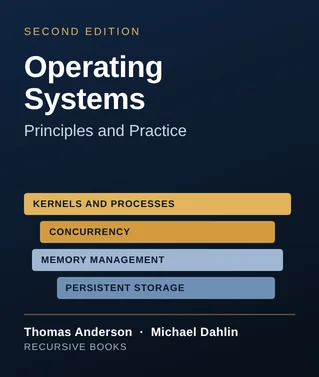
English Title : Operating Systems: Principles and Practice
عنوان فارسی : کتاب سیستم عامل: اصول و عمل
Description
Operating Systems: Principles and Practice is a textbook for a first course in operating systems, written by two researchers who have taught the subject for many years at the University of Washington and the University of Texas at Austin. Rather than describing one particular system, the book explains the ideas that every modern operating system is built on: how the kernel protects itself and the programs it runs, how many activities share one machine safely, how memory is translated and cached, and how data survives crashes and failures.
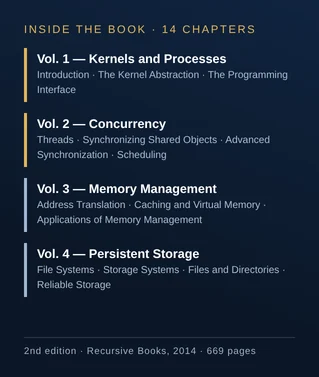
The second edition is organized in four parts. Kernels and Processes covers the kernel abstraction and the programming interface. Concurrency covers threads, synchronization of shared objects, advanced synchronization and CPU scheduling. Memory Management covers address translation, caching and virtual memory, and the applications of memory management. Persistent Storage covers file systems, storage devices, files and directories, and reliable storage. The print edition is a single volume of 669 pages; the e-book is published as four separate volumes that follow the same four parts.
For Iranian students, the book is one of the references named for the operating systems course in the official computer engineering bachelor's curriculum, and it is a useful companion to the classic texts by Silberschatz, Stallings and Tanenbaum when preparing for the operating systems part of the master's entrance exam in computer engineering.
Table of contents
Volume 1: Kernels and Processes
1 Introduction
2 The Kernel Abstraction
3 The Programming Interface
Volume 2: Concurrency
4 Concurrency and Threads
5 Synchronizing Access to Shared Objects
6 Advanced Synchronization
7 Scheduling
Volume 3: Memory Management
8 Address Translation
9 Caching and Virtual Memory
10 Applications of Memory Management
Volume 4: Persistent Storage
11 File Systems: Introduction and Overview
12 Storage Systems
13 Files and Directories
14 Reliable Storage

Michael Dahlin
Michael Dahlin is an engineer at Google and was a professor of computer science at the University of Texas at Austin from 1996 to 2014. He received his Ph.D. in computer science from UC Berkeley in 1995. His work spans large-scale distributed systems, fault tolerance, security, operating systems and storage systems, and he has written more than seventy peer-reviewed papers, ten of which won best-paper awards. He is a Fellow of both the ACM and the IEEE, and has received an Alfred P. Sloan Research Fellowship, an NSF CAREER award and the College of Natural Sciences Teaching Excellence Award at UT Austin.

Thomas Anderson
Thomas E. Anderson holds the Warren Francis and Wilma Kolm Bradley Chair of Computer Science and Engineering at the University of Washington, where he has taught since 1997; before that he was a faculty member at UC Berkeley. He earned his Ph.D. in computer science at the University of Washington in 1991. His research covers operating systems, distributed systems, computer networks, multiprocessors and computer security, and he has published more than one hundred peer-reviewed papers, eighteen of which won best-paper awards. He is an ACM Fellow and a member of the National Academy of Engineering (elected in 2016), and his honors include the ACM SIGOPS Mark Weiser Award, the USENIX Lifetime Achievement Award and the IEEE Koji Kobayashi Computers and Communications Award.